
A Review Paper on Causal Inference and Infectious Disease Determinants within the One Health Framework has been Published

A review paper authored by Sewwandi Bandara and colleagues from our laboratory, discussing the importance of causal inference for targeted public health interventions within the One Health framework, has been published in the Journal of Water and Health.

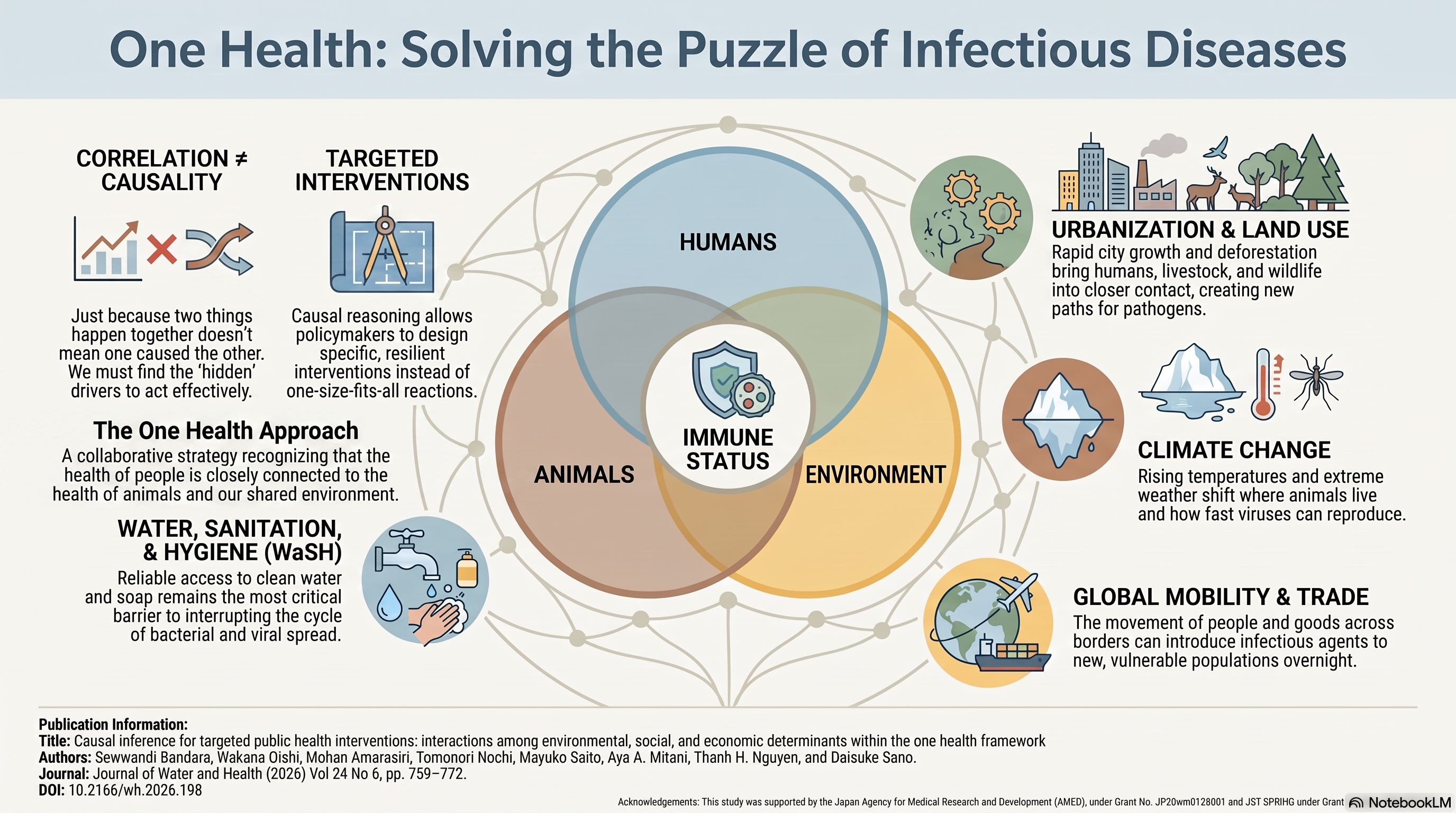
The One Health framework emphasizes the interconnection between human, animal, and environmental systems in shaping infectious disease dynamics. Based on this concept, the paper systematically reviews how various environmental, social, and economic determinants—specifically urbanization, climate change, land-use change, population mobility, and water, sanitation, and hygiene (WaSH) conditions—interact to drive the transmission of infectious diseases.

The authors highlight that no single determinant independently drives disease transmission; rather, overlapping exposures and interactions create complex feedback loops that amplify public health vulnerabilities. While conventional approaches to assessing these factors have mostly been correlation-based, this paper strongly advocates for the integration of causal inference to move beyond simple associations and uncover the true cause-and-effect mechanisms. 

By embedding causal reasoning within the One Health framework, it becomes possible to strengthen evidence-based policy and support the design of targeted, context-specific, and resilient public health interventions aimed at reducing the burden of infectious diseases.

Causal inference for targeted public health interventions: interactions among environmental, social, and economic determinants within the one health framework
Sewwandi Bandara, Wakana Oishi, Mohan Amarasiri, Tomonori Nochi, Mayuko Saito, Aya A. Mitani, Thanh H. Nguyen, and Daisuke Sano
Journal of Water and Health, 24(6), 759 – 772, 2026.

This study was supported by the Japan Agency for Medical Research and Development (AMED), under Grant No. JP20wm0125001 and JST SPRING under Grant Number JPMJSP2114.
 

Previous Post
Water and Environment Technology Conference 2026 (WET2026)

Related Articles

An article of Assoc. Prof. Sano has been posted at Special Issue Author Blog Post for Journal of Water and Health

What do we know about antimicrobial resistance in aquatic environments? On the release of an important new Special Issue, Editors of Journal of Water & Health tell us more about this crucial topic in water and sanitation. Maronel Steyn, Tasha M. Santiago-Rodriguez, Daisuke Sano & Gary Toranzos https://www.iwapublishing.com/news/special-issue-water-health-author-blog-post

Technical brief on water, sanitation, hygiene (WASH) and wastewater management to prevent infections and reduce the spread of antimicrobial resistance (AMR)

Assoc. Prof. Sano contributed to the publication of WHO technical brief with regards to antimicrobial resistance (AMR) and water, sanitation, hygiene (WASH) and wastewater management. Technical brief on water, sanitation, hygiene (WASH) and wastewater management to prevent infections and reduce the spread of antimicrobial resistance (AMR) Authors: World Health Organization, Food and Agriculture Organization, World Organization for Animal Health https://www.who.int/water_sanitation_health/publications/wash-wastewater-management-to-prevent-infections-and-reduce-amr/en/
Academic paper

COVID-19 case prediction via wastewater surveillance in a low-prevalence urban community: a modeling approach

Our work with regards to COVID-19 case prediction using wastewater surveillance results has been published in Journal of Water and Health: COVID-19 case prediction via wastewater surveillance in a low-prevalence urban community: a modeling approach Yifan Zhu; Wakana Oishi; Chikako Maruo; Sewwandi Bandara; Mu Lin; Mayuko Saito; Masaaki Kitajima; Daisuke Sano J Water Health (2022) 20 (2): 459–470.